Quick question: are you sitting down right now?
If you are like most of us, you probably spend hours every day in a chair - at a desk, in the car, at the dining table, in front of the TV. And even if you walk or practise yoga in the morning, the rest of the day your leg muscles are mostly switched off.
Here is the good news. There is a small muscle in your calf that can keep working for you while you sit, and waking it up takes nothing more than lifting your heels. No gym, no sweat, no special clothes. Nobody around you will even notice.
Let me introduce you to the soleus.
Meet the soleus: the quiet worker in your calf
Run your hand down the back of your lower leg. The rounded muscle you feel near the top is the one everyone knows. Tucked underneath it is a flatter, deeper muscle called the soleus.
Most muscles are sprinters - they work hard for a short while and then tire. The soleus is a marathon runner. It is built almost entirely from endurance fibres, so it can keep working gently for hours without getting tired. That is why it holds you upright every time you stand and supports every step you take.
It also has a lovely nickname: your "second heart". Every time your calf muscles squeeze, they help push blood from your legs back up towards your heart.
And scientists have discovered it can do something even more remarkable.
The discovery: a muscle that soaks up sugar
In 2022, researchers at the University of Houston found a way to keep the soleus working continuously while people simply sat in a chair. They called it the Soleus Push-Up.
When a working muscle needs fuel, it pulls sugar and fat straight out of your blood. Most muscles can only do this for a short time. The soleus can do it for hours. So when volunteers did soleus push-ups after a sugary drink, their blood sugar behaved very differently.
The benefits: small movement, big results
Here is what the research has found so far:
- About half the sugar spike after eating. People doing soleus push-ups had roughly 52% less rise in blood sugar after a sugary drink than when they sat still.
- Much less insulin needed. Their bodies needed about 60% less insulin to handle the same drink. Less pressure on the body's sugar-control system is good news for anyone worried about diabetes.
- Fats cleared from the blood faster. The working soleus also burns fats floating in the blood after a meal.
- Calmer inflammation. In a 2025 study, people with heart disease who did soleus push-ups three times a day for three months had clearly lower inflammation markers in their blood than those who didn't.
- Better cholesterol. The same group saw their "bad" LDL cholesterol go down and their "good" HDL cholesterol go up.
- Happier legs. Moving your heels keeps your "second heart" pumping, which helps legs and ankles feel less heavy and stiff after long hours of sitting.
- Energy without exhaustion. It is so gentle that you can keep going for minutes at a time without getting out of breath.
Think about that for a moment. A movement this small, done in your chair, can help your body handle a meal in a completely different way. That is the kind of health habit almost anyone can keep.
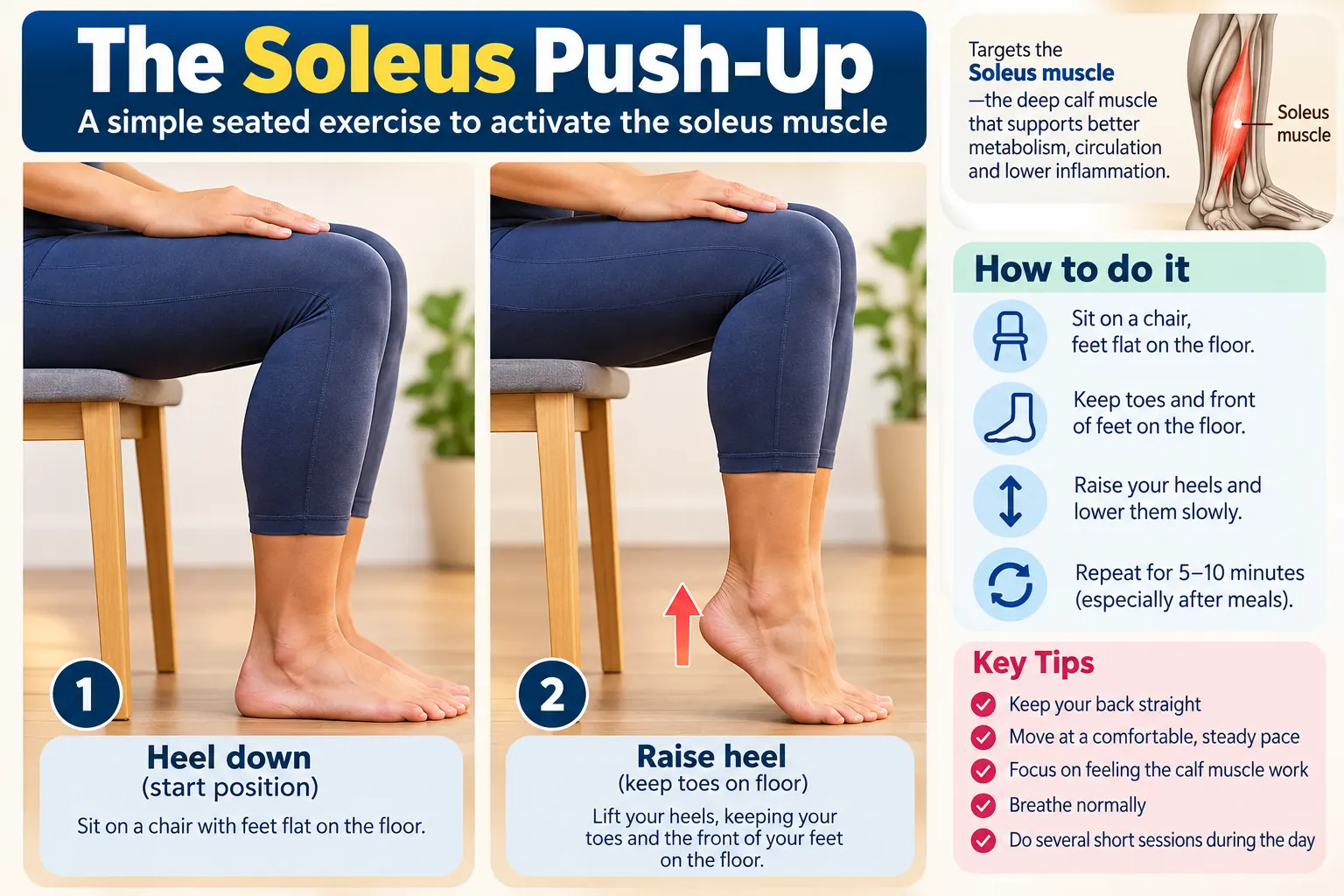
How to do the Soleus Push-Up
It is honestly this simple:
- Sit on a chair with your feet flat on the floor and your knees bent at about a right angle.
- Lift your heels as high as feels natural, keeping your toes and the balls of your feet on the floor.
- Lower your heels back down.
- Repeat at a steady, easy rhythm. Keep breathing normally.
That's it. Start with one or both legs, whichever feels comfortable.
Three tips to get it right
- Keep it gentle. This is not a calf workout. Think "light and steady", not "hard and fast". You should be able to chat or type while you do it.
- Keep your knees bent. Sitting with bent knees is exactly what makes the soleus, rather than the bigger calf muscle, do the work.
- Keep your upper body relaxed. Only your heels move. Shoulders soft, jaw loose.
Fit it into your day (without changing your day)
The beauty of the soleus push-up is that you don't need to find extra time. You simply attach it to things you already do sitting down:
- After every meal - this is the most powerful moment. Sit back for 8 to 10 minutes and let your heels move while you chat or sip water.
- During meetings and video calls - under the table, nobody will ever know.
- While working at your computer - every time you answer an email, move your heels.
- While watching TV - one episode is plenty of practice time.
- On your phone - scrolling time becomes soleus time.
- When travelling - on trains, buses and flights, it keeps your legs happy.
In the heart study, people did it three times a day, for at least eight minutes, about an hour after meals. That is a wonderful target to aim for, but even a few minutes is a great start. Something is always better than sitting completely still.
Try the 7-day soleus challenge
Want to build the habit? Try this for one week:
- Days 1 and 2: 3 minutes after lunch.
- Days 3 and 4: 5 minutes after lunch and dinner.
- Days 5 to 7: 8 minutes after breakfast, lunch and dinner.
By the end of the week, your heels will start moving almost on their own whenever you sit down after eating. That is when a habit becomes effortless.
Bring it onto your yoga mat too
Yoga already loves the lower legs. These familiar poses keep your calves and ankles working and pair beautifully with your seated practice:
- Tadasana (Mountain Pose) - stand tall and barefoot for a minute and feel your ankles making tiny adjustments. That is your soleus holding you up.
- Utkatasana (Chair Pose) - with knees bent, slowly lift and lower your heels a few times. This is the standing cousin of the soleus push-up.
- Vrikshasana (Tree Pose) - balancing on one leg keeps the standing ankle busy. Keep that knee slightly soft.
- Warrior poses - move slowly in and out of them rather than just holding.
- Downward-Facing Dog - gently "pedal" your heels, lowering one and then the other.
Yoga builds strength, balance and calm, while the soleus push-up fills the long hours in between. Together they keep your body moving the way it was designed to. You can find step-by-step guidance for these poses in our free pose library.
Who will love this?
- Office workers and anyone at a desk all day
- Drivers and frequent travellers
- People watching their blood sugar, or with prediabetes or diabetes
- Anyone working on their cholesterol or heart health
- Older adults and anyone for whom long walks are difficult
- Busy people who "never have time to exercise"
A few gentle notes
The soleus push-up is safe and gentle for most people. But if you have diabetes (especially if you take insulin or sugar-lowering tablets), a heart condition, or any problem with your legs, feet or circulation, please check with your doctor first. And remember, it is a wonderful addition to walking, yoga and a healthy diet, not a replacement for them or for your medicines.
Start right now
You are probably still sitting. So why not begin this very moment? Feet flat, knees bent, and... lift, lower, lift, lower.
Congratulations - your soleus is awake.
Sit less, move more, and whenever you must sit, keep your heels moving.
If you would like a gentle, personalised practice for blood sugar, heart health or simply more energy through the day, take a look at our yoga for diabetes programme or book a personalised session with me.
Research behind this article
- Hamilton MT, Hamilton DG, Zderic TW. A potent physiological method to magnify and sustain soleus oxidative metabolism improves glucose and lipid regulation. iScience. 2022.
- Gökaslan S, et al. Effects of soleus push-up exercise on systemic immune-inflammatory index and blood lipid profile in coronary artery disease. Medicine. 2025.
This article is for general education only and is not medical advice.